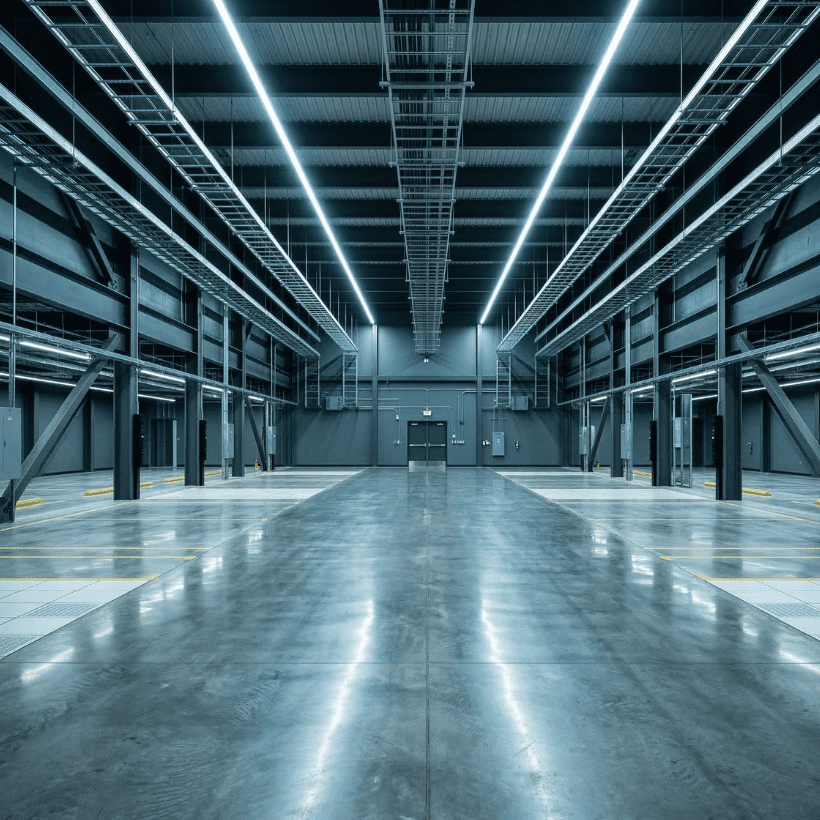
Engineered Empty. Ready for Everything.

Choosing a data hall is just the beginning. What happens inside the module, every rack row, every breaker placement, every cable path, is just as critical to your operations as the infrastructure you bring through the door.

At DST Data Centers, we understand that our customers don't just need square footage. They need a space that has already been thought through completely, where every configuration decision has been mapped, every power scenario has been modeled, and every possible layout has been anticipated before you ever arrive. That is why we design every data module as if it were already full, because the work we do before you move in is what makes everything after move-in seamless.

Whatever density you require, whatever layout you choose, whatever fit-out you need built, we are ready to make it happen.

How We Prepare Your Module

01. Model Every Scenario

Before we hand you the keys, we have already done the mathematics. Where can racks go? Where can breakers, outlets, and network connections be placed? What does the module look like at 24 rows versus 30? What happens under maximum load? We work through every permutation so that when you make your configuration decisions, the infrastructure is already waiting for you — with 300 watts per gross square foot ready to power your most demanding high-density applications.

Our 4MW modules of up to 15,000 square feet are laid out around slab flooring in the vast majority of cases, with 24 to 30 rack rows and a minimum ceiling height of 12′6″ for easier cabling and maintenance. If a raised floor is required, our designs accommodate rack weights greater than two tons — a minimum of 250 pounds per square foot. Highly efficient positive pressure hot aisle containment is achieved in part by siting CRAH units outside your data module, on opposite sides, leaving more room for your racks and ensuring maintenance is always performed away from your critical IT infrastructure.

Data modules are provisionally lit to code and await your final layout confirmation. Once determined, we complete lighting installation using LED fixtures fully compliant with California Title 24 Building Energy Efficiency Standards. Fire systems are either VESDA or high-sensitivity smoke detection devices. Every doorway and elevator opening — from 9′ to 10′8″ — is designed so that moving equipment in is straightforward and safe from loading dock to module floor.

If you need more than a shell, we are ready to deliver a complete fit-out. From power distribution — both RPP and busway — to low-voltage cable conveyance and containment, our team works with you on every element of the design. When we hand over your module, it is ready to run.

  • Model Every Scenario

Data Hall Infrastructure Outcomes

Six Ways DST Data Centers Engineers Your Module for Any Configuration

1. 300 Watts Per Gross Square Foot: Every data module is designed to deliver 300 watts per gross square foot — sufficient power density for today's most demanding high-density compute, AI, and GPU workloads. Whatever density you bring, the infrastructure is already built to meet it.

2. 4MW Modules Up to 15,000 Square Feet: Our standard modules deliver 4 megawatts of capacity across up to 15,000 square feet of configurable data hall space. The scale is there from day one, purpose-built for enterprise deployments that need room to grow without the constraints of a smaller, under-engineered environment.

3. Every Layout Scenario Engineered in Advance: Before you make a single configuration decision, we have already modelled every rack scenario, every breaker placement, every outlet position, and every network connection point. When you arrive, the module is ready for your choice, not designed around ours.


4. Structural Design for High-Density Rack Weight: Slab flooring supports racks of 4,000 pounds and greater as standard. Where a raised floor is required, our designs deliver a minimum of 250 pounds per square foot, ensuring that the heaviest modern deployments are accommodated without structural compromise or operational risk.

5. Thermally Optimised Hot Aisle Containment: Positive pressure hot aisle containment with CRAH units sited outside the module on opposite sides delivers a thermally stable, highly efficient environment. More room for your racks, maintenance always performed away from live infrastructure, and a working atmosphere that your team can operate in comfortably across every shift.

6. A Module Designed to Be Handed Over Complete: From provisional lighting awaiting your final layout to a full fit-out encompassing RPP and busway power distribution, low-voltage cable conveyance, and containment systems, we are ready to deliver as much or as little as you need. When we hand over your module, every element has been planned, installed, and verified so that your operations begin without delay.